Buntes Garten Ciao
Participate in Events
–

When:
Fri, July 17, 2026, 6pm–7pm
Free admission
Duration:
approx. 1 hour
Meeting point:
Lenbachhaus Garden (in case of bad weather, in the foyer)
No registration required.
This reading will be in English and contains sexualy explicit language.
When:
Fri, July 17, 2026, 6pm–7pm
Free admission
Duration:
approx. 1 hour
Meeting point:
Lenbachhaus Garden (in case of bad weather, in the foyer)
No registration required.
This reading will be in English and contains sexualy explicit language.
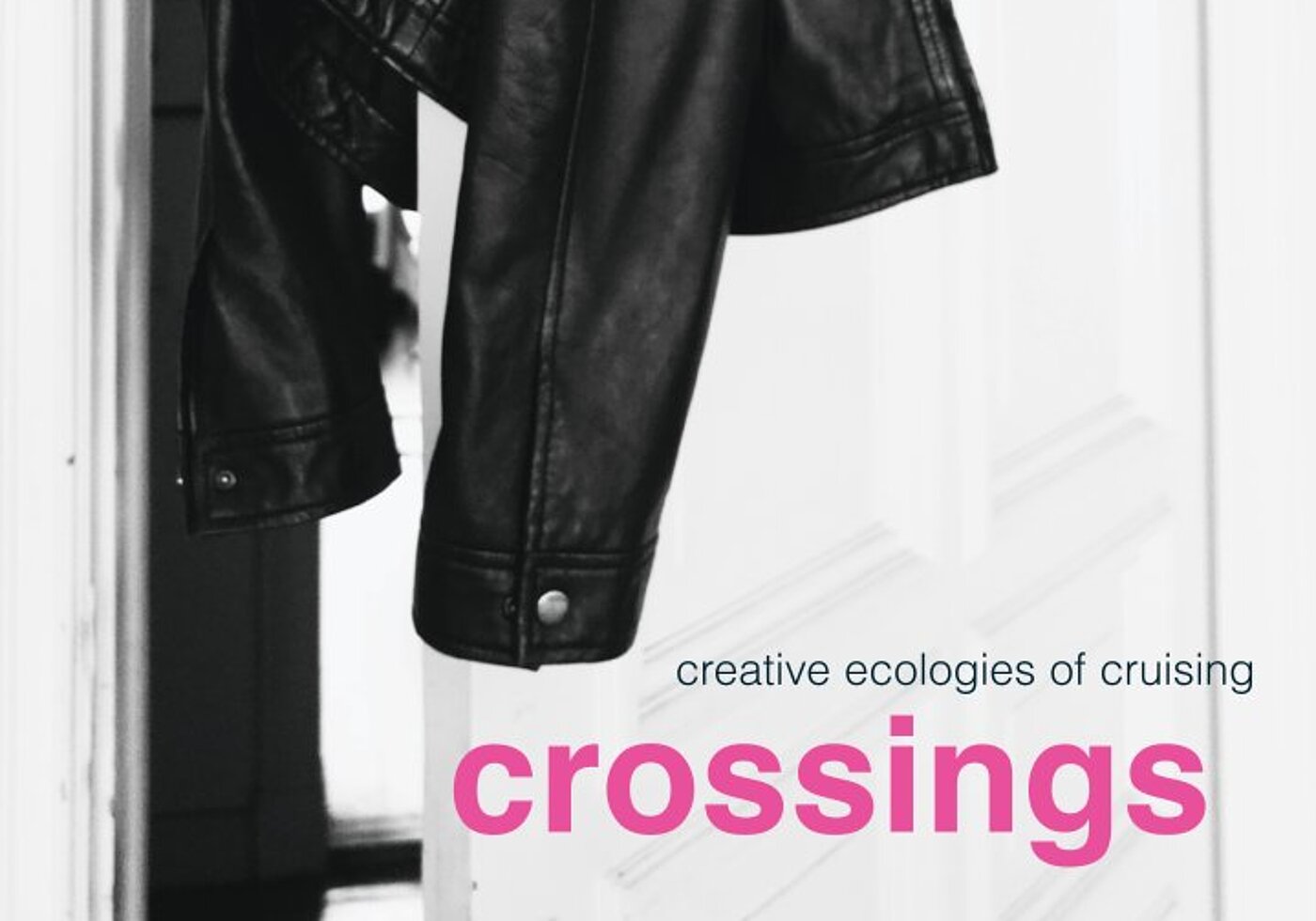
It’s difficult to pinpoint the origins of cruising. While the term was used by men seeking casual encounters with other men in the parks and streets of New York City as early as the 1920s, historical records show the practice is much older. Cruising has existed for as long as anyone outside the dominant sex and gender systems has sought sexual encounters outside of sanctioned norms. This book offers a serious exploration of queer sex and sex cultures, exploring cruising as a mode of thinking with the body and communicating through sexuality.
A creative dialogue between a queer artist and a queer academic reminiscing about and thinking with their cruising experiences, Crossings takes queer sex practices and cultures seriously as ways of knowing and world-making. The result is an erotic hybrid form hovering between scholarship and avant-garde experimentation, between critical manifesto and sex memoir. Here, the voices of each author, merged together in one, invite the reader to inhabit the erotic spacetime between self and other, the familiar and the strange, desire and pleasure, climax and release. That is, the spaces and temporalities of cruising itself.
Q&A with Liz Rosenfeld and Leah Marojevic.
Biography:
Liz Rosenfeld is a transdisciplinary artist, writer, and educator whose artistic practice spans performance/ experimental choreographies, film, drawing and literary work. Rooted in the body as the ones main informant, Liz’s projects explore complex histories of queerness, shifting community structures, and the ways in which queer positionality transforms in the face of political urgency. With a focus on the sustainability of emotional and political ecologies, placing a specificity on re-occurring explorations such as potentiality of holes, queer cruising methodologies, and entangled past/future political histories. Liz’s work examines flesh as a collaborative, non-binary material, engaging questions of abundance, excess, and the politics of taking up space. Liz’s writing, in poetic auto- theoretical style, interrogates questions around queer art and politics shaped by contradictory desires, the de- linearity of intimacies, and notions around the questions regarding how does one build a body?
Liz’s inaugural book, Crossings: Creative Ecologies of Cruising, co-written with Professor Joao Florencio and published by Rutgers University Press (2025), launched internationally at venues such as The Tate Modern, The Bureau of General Services—Queer Division (New York), and Chert Luedde Books (Berlin). Liz’s essays, performance texts and poems have been widely published in anthologies, journals and art magazines. Liz is an Associated Lecturer at Rose Bruford College, London, in queer art history and theory in the MA Performance program, and is also a recurring guest educator at KEM Art School in Warsaw.
Access note:
In good weather, the reading will take place in the garden, where garden chairs and folding chairs are available. Non-barrier access is via the main entrance of the Lenbachhaus, past the ticket office on the right, through the door and down the stairs.
Barrier-free access to the garden is via the gate on Luisenstraße. Our security staff will be happy to open the gate for you. You can reach our staff on +49 89 233 66300. There are gravel paths in the garden.
In case of rain, the reading will take place in the foyer of the Lenbachhaus. The main entrance is accessible. The entire Lenbachhaus is wheelchair accessible. There are two public disabled parking spaces on Luisenstraße.
More information here.
