
Günter Fruhtrunk. The Paris Years (1954–1967)
–

In 1981, the newsweekly “Stern” ran a satirical drawing that has since become famous: West German Chancellor Helmut Schmidt, in the midst of the East-West conflict, sits, between vodka and Coca-Cola, on a sofa in his bungalow—on the wall above him a painting by Günter Fruhtrunk. A year before his death, Fruhtrunk, a professor at the Munich Academy, was widely hailed as one of the Federal Republic’s leading exponents of concrete art. His design for the Aldi-Nord shopping bag in its aloof distinctiveness deservedly became iconic first in West, then in reunified Germany.
But Fruhtrunk’s career had begun decades earlier, in France: in the early 1950s, the young artist, living in the French occupation zone in southwest Germany, did everything in his power to get to Paris, home to the most innovative champions of a painting liberated from the task of representation. There he hoped to develop his own style. In 1954, he finally moved to the French capital, where he lived until his appointment to the teaching position in Munich in 1967, and he maintained a home in France even afterwards. Working with exceptional precision and patience, he painted pictures that were meant to be free of the artist’s personal or interpretational aspirations, that wanted to be pure “articulated chromatic texture of the greatest luminosity.” His objective was nothing less than the “freedom of seeing.”
He was supported by influential veterans of the prewar avant-garde and represented by Galerie Denise René, which gathered the most uncompromising exponents of a constructive abstraction. Fruhtrunk was tireless in his efforts to enlarge his transnational network of artists, critics, philosophers, gallerists. His first solo exhibitions were held in Paris, Milan, Marseille, and it was from France that he built a German audience for his work.
Our exhibition zooms in on this prolific period in Fruhtrunk’s life and oeuvre and sets it in the context of the Franco-German art relations in the 1950s and 1960s. Around sixty works with which he presented himself to the public at the time convey a vivid sense of the contemporary beholders’ experience.
Concurrently, the Kunstmuseum Bonn will present a Günter Fruhtrunk retrospective that will travel to the Museum Wiesbaden.
The exhibition is accompanied by the publication "Günter Fruhtrunk: Die Pariser Jahre (1954-1967)" (in German).
Edited by Susanne Böller and Matthias Mühling
Edition Lenbachhaus 9, 263 pages, 191 illustrations, 20 EUR.
Order catalogue
With generous support of Förderverein Lenbachhaus e.V.
Media Partner

Statements
„Und gegenstandlose Kunst zeigt: nur sich selbst. Sie erzählt keine Geschichten, ist keine Spielwiese für Rätselratende oder Gscheidhaferl; sie ist. Günter Fruhtrunk wollte dabei so konsequent wie möglich sein. Nicht mal Pinselstrich sollte auf schöpferische Hand verweisen oder gar auf die Gefühle des an ihr hängenden Menschen. Bloß kein Getue. Dafür Freiheit. [...] Die für Fruhtrunk so typischen meist schrägen Bänder tanzen hier [Seriengrafien der Mappe „Metastabile Kompositionen“] dermaßen frech und kess, dass von Kälte nicht die Rede sein kann. Menschen, die sich Zeit nehmen, werde zur eigenen Überraschung vieles erschauen, was still und fast unsichtbar entscheidend zur Wirkung beiträgt; nichts kann ohne den Nachbarn, den Nächsten existieren: Vielleicht hat Günter Fruhtrunk ja darin die ethische Aussage seiner Kunst versteckt.“
„Objektiv und gefühlskalt? Von wegen! Die Bilder von Günter Fruhtrunk handeln von der Komplexität des Erkennens, Wahrnehmens, Denkens.“
"Fulminante späte Grüße: Zum 100. Geburtstag Günter Fruhtrunks im Mai präsentiert das Lenbachhaus eine große Ausstellung über die Pariser Jahre des großen Münchner Künstlers. Von Energie ist viel die Rede. Die Farben springen ja fast aus den Bildern, wie Raubkatzen in der Manege: saftiges Grasgrün und knalliges Rapsgelb, starkes Royalblau und dazwischen undurchdringliches Schwarz, das wie ein Dompteur unerbittlich für Ordnung sorgt […].“
"Nein, das sind keine Streifen. Es sind Spuren einer großen, nicht fasslichen Bewegung."
"In seiner Geburtsstadt München konzentriert sich das Lenbachhaus auf die Jahre, die Fruhtrunk in Frankreich verbracht hatte. […] Von Frankreich aus interessierte er dann auch nach und nach das deutsche Publikum für sich und seine rigorosen und doch poppigen perfekten Balken. Eine Bildsprache, die er mit großer Geduld und Genauigkeit entwickelte. Dabei ging es ihm um nichts weniger als das 'Freisein des Sehens'".
„Die Farbe, sie war sein Zuhause. Sie war für Günter Fruhtrunk nicht nur Medium, sondern auch der Inhalt seiner Kunst. [...] [Die] „Pariser Jahre“, denen das Lenbachhaus in München anlässlich [Günter Fruhtrunks] 100. Geburtstages im vergangenen Jahr eine Ausstellung widmet […] stellt erstmals diese für ihn sehr wichtige Schaffenszeit ins Zentrum und zeigt, wie prägend die Jahre 1954 bis 1967 für die Herausbildung seines Stils und für sein Schaffen waren.“
Works
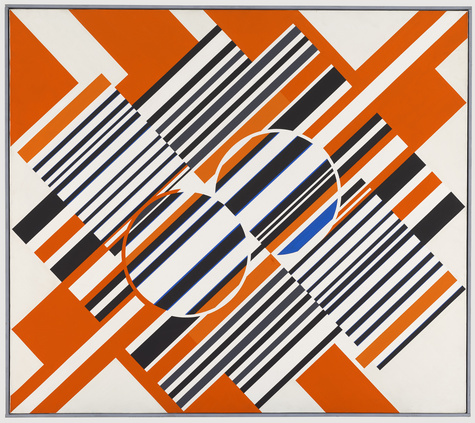
Günter Fruhtrunk
Umkehrende Reihe, 1962/63
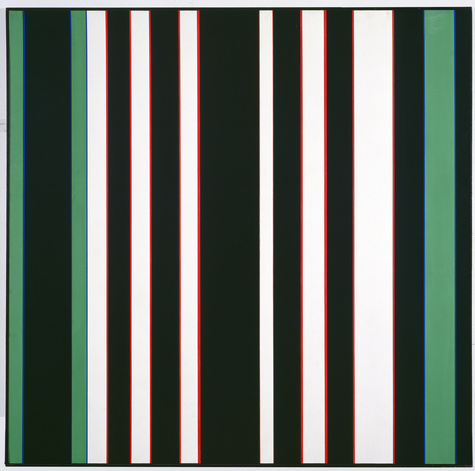
Günter Fruhtrunk
Rote Vibration, 1968
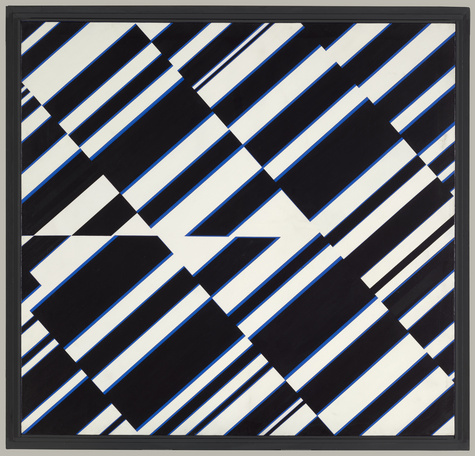
Günter Fruhtrunk
Energiezentrum, 1960/61 (1963/64)
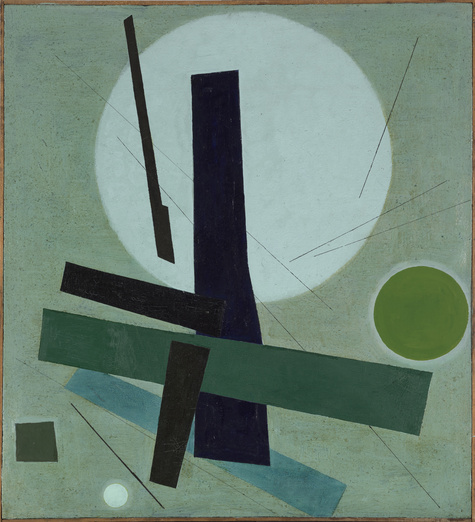
Günter Fruhtrunk
Monument für Malewitsch, 1954
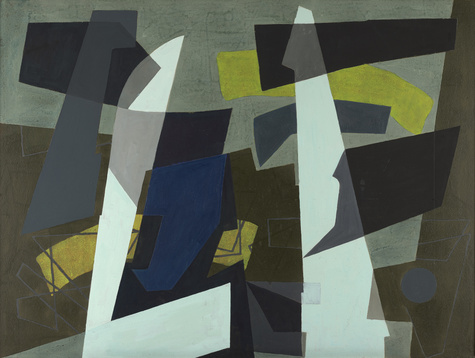
Günter Fruhtrunk
Blauform und Gelbklang, 1953/1954
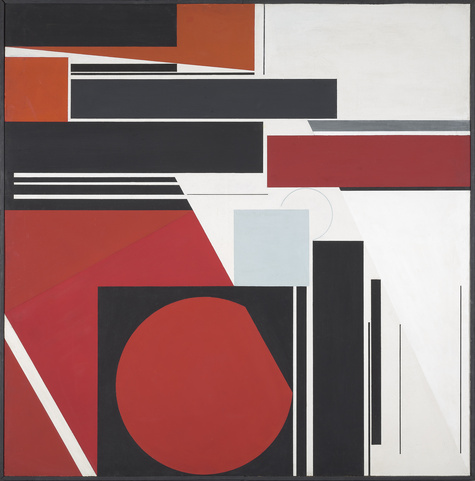
Günter Fruhtrunk
Gestaltung ins Quadrat, 1959

Installation views
- Installation Shot, "Günter Fruhtrunk. The Paris Years (1954-1967)", Lenbachhaus, 2023. Photo: Lukas Schramm, Lenbachhaus
- Installation Shot, "Günter Fruhtrunk. The Paris Years (1954-1967)", Lenbachhaus, 2023. Photo: Lukas Schramm, Lenbachhaus
- Installation Shot, "Günter Fruhtrunk. The Paris Years (1954-1967)", Lenbachhaus, 2023. Photo: Lukas Schramm, Lenbachhaus
- Installation Shot, "Günter Fruhtrunk. The Paris Years (1954-1967)", Lenbachhaus, 2023. Photo: Lukas Schramm, Lenbachhaus
- Installation Shot, "Günter Fruhtrunk. The Paris Years (1954-1967)", Lenbachhaus, 2023. Photo: Lukas Schramm, Lenbachhaus
- Installation Shot, "Günter Fruhtrunk. The Paris Years (1954-1967)", Lenbachhaus, 2023. Photo: Lukas Schramm, Lenbachhaus
- Installation Shot, "Günter Fruhtrunk. The Paris Years (1954-1967)", Lenbachhaus, 2023. Photo: Lukas Schramm, Lenbachhaus
- Installation Shot, "Günter Fruhtrunk. The Paris Years (1954-1967)", Lenbachhaus, 2023. Photo: Enst Jank, Lenbachhaus
- Installation Shot, "Günter Fruhtrunk. The Paris Years (1954-1967)", Lenbachhaus, 2023. Photo: Enst Jank, Lenbachhaus
- Installation Shot, "Günter Fruhtrunk. The Paris Years (1954-1967)", Lenbachhaus, 2023. Photo: Enst Jank, Lenbachhaus
